
Unlocking mathematical concepts through playful card games offers a dynamic learning experience! Numerous printable PDFs detail engaging activities, supplementing traditional lessons with fun, accessible practice.
These resources cover diverse skills, from basic arithmetic to fractions, making math enjoyable for all ages and abilities.
Why Use Cards for Math?
Utilizing a standard deck of cards for math practice presents a uniquely versatile and accessible learning tool. Unlike specialized materials, cards are readily available and familiar, reducing initial barriers to engagement.
The inherent randomness of card draws introduces an element of chance, fostering adaptability and problem-solving skills. Printable PDF resources often leverage this, offering structured games that reinforce core concepts like addition, subtraction, multiplication, and fractions.
Cards promote active participation and a less intimidating learning environment, particularly beneficial for students who experience math anxiety. They transform practice into a playful activity, enhancing retention and understanding.
Benefits of Card-Based Math Practice
Card-based math games offer a multitude of cognitive benefits beyond rote memorization. They cultivate strategic thinking, as players must adapt to changing card combinations and devise effective solutions. PDF game guides frequently emphasize this, structuring challenges to encourage planning and foresight.
These games also enhance number sense and mental math abilities, as quick calculations are often required. The tactile nature of cards can aid kinesthetic learners, while the competitive element boosts motivation.
Furthermore, card games promote social interaction and communication skills when played collaboratively, fostering a positive attitude towards mathematics.

Basic Card Values in Math Games
Standard card values are crucial: Ace can be 1 or 11, while Jacks equal 11, Queens 12, and Kings 13, as detailed in PDF guides.
Assigning Numerical Values to Cards
Establishing clear card values is fundamental for successful math games. Most PDF resources advocate for a straightforward system: number cards retain their face value (2-10). However, the Ace presents a delightful dilemma – often assigned a value of 1, but frequently adaptable to 11, adding strategic depth.
Face cards – Jack, Queen, and King – typically represent 11, 12, and 13 respectively. These values are consistently outlined in downloadable game instructions. Remember, the suits (hearts, diamonds, clubs, spades) generally hold no mathematical significance, simplifying gameplay. Utilizing these standardized values, found within numerous math card game PDFs, ensures fairness and focuses learning on numerical operations.
Ace as 1 or 11: Game Variations
The Ace’s dual nature – representing either 1 or 11 – introduces exciting variability in card-based math games. Many PDF guides detail how this flexibility enhances strategic thinking. Some games fix the Ace’s value at 1, simplifying calculations for younger learners. Others allow players to choose, mirroring Blackjack’s dynamic.
Advanced math card game PDFs often incorporate rules where the Ace’s value changes mid-game, based on the current total. This encourages adaptable problem-solving. Understanding these variations, clearly explained in downloadable resources, is key to maximizing the educational benefits and enjoyment of these card games.
Face Card Values (Jack, Queen, King)
Assigning values to Jack, Queen, and King is crucial for diverse card game applications. Most math card game PDFs standardize these as 11, 12, and 13 respectively, expanding the numerical range. Some resources suggest simplifying by assigning a uniform value of 10 to all face cards, easing calculations for beginners.
More complex PDF guides explore variations where face card values are dynamic, tied to specific game rules or player choices. These variations promote strategic thinking and a deeper understanding of number relationships. Consistent value assignment, detailed in downloadable resources, ensures fair and engaging gameplay.

Addition and Subtraction Games
PDF resources showcase simple addition using number cards, and subtraction challenges finding differences. Target number games, detailed in guides, boost arithmetic fluency!
Simple Addition with Number Cards
Utilizing a standard deck, remove face cards initially for focused practice. PDF guides often suggest starting with cards 2-10. Players flip two cards, adding their values – a foundational skill! This builds number sense and quick recall.
Variations include timed challenges or competitive scoring. Some printable resources introduce a “target number,” requiring players to combine cards to reach it. This encourages strategic thinking. Adaptations can involve adding three or more cards for increased complexity, gradually building addition proficiency. These games are easily found online, offering diverse levels of difficulty.
Subtraction Challenges: Finding the Difference
Employing number cards, players draw two cards – the larger value becomes the minuend, the smaller the subtrahend. PDF game instructions frequently emphasize starting with smaller numbers. The goal is to accurately determine the difference. This reinforces the concept of taking away.
Introduce variations like “Subtraction War,” where players simultaneously reveal cards, and the fastest to calculate the difference wins. Some printable resources incorporate target differences. Gradually increase the card values to challenge learners. These games build fluency and problem-solving skills, readily available online.
Target Number Games: Addition & Subtraction
Utilizing a deck of cards, a target number is established – often found within printable PDF game guides. Players then draw cards, aiming to reach the target through addition or subtraction. This fosters strategic thinking and number sense.
Variations include limiting the number of cards used or requiring specific operations. Some PDFs suggest point systems for accuracy and speed. Encourage players to explore multiple solution paths. These games promote mental math skills and adaptability, making learning engaging and reinforcing core arithmetic concepts.

Multiplication and Division Games
PDF resources showcase “Multiplication War” and equal-dealing division exercises using cards! These games build fluency and problem-solving skills in a fun, competitive format.
Multiplication War: A Fast-Paced Game
Multiplication War is a thrilling card game perfect for reinforcing times tables! PDF guides detail the simple rules: players simultaneously flip two cards, multiplying the numbers together.
The player with the higher product wins both cards. Face cards (Jack, Queen, King) are assigned values of 11, 12, and 13 respectively, while Aces typically equal one.
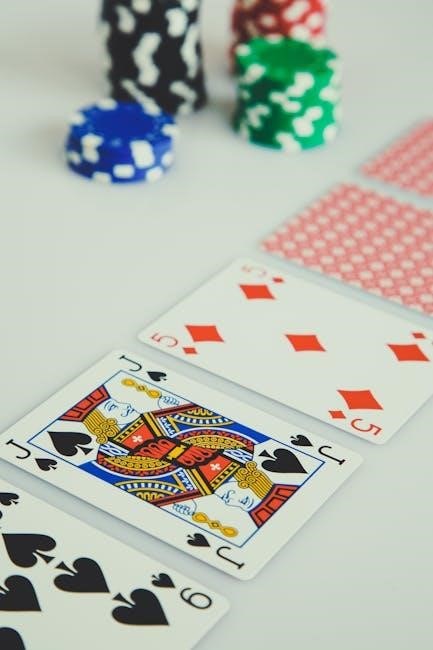
This fast-paced competition encourages quick recall of multiplication facts. Variations can include using only specific times tables or incorporating fractions for an added challenge. It’s a fantastic way to practice and build confidence!
Division Practice: Dealing Cards Equally
Division practice becomes engaging with a deck of cards! Many PDF resources outline games where players deal cards into equal groups, practicing division skills.
For example, a player might draw a card representing the total number of items and then deal them equally amongst a set number of “players” (represented by other cards).
This hands-on approach helps visualize the concept of division and understand remainders. Variations can involve finding factors or creating division equations. It’s a fun, interactive way to master this essential math skill!
Fact Family Games with Cards
Fact family games using cards reinforce the relationship between addition and subtraction, or multiplication and division. PDF guides often include variations where players draw three cards to form a fact family.
For instance, drawing 3, 5, and 8 could create the equations 3 + 5 = 8 and 8 ⎻ 5 = 3. Players can challenge each other to create as many fact families as possible within a time limit.
This activity strengthens number sense and demonstrates how operations are interconnected, building a solid foundation for more complex math concepts.

Fraction Games with a Deck of Cards
Cards represent fractions, fostering comparison and equivalence understanding! PDF resources detail games where card values become numerators or denominators, simplifying fraction operations.
Representing Fractions with Cards
Utilizing a standard deck, cards can visually embody fractional concepts. Assign the denominator as the card’s suit – hearts, diamonds, clubs, or spades – representing the total parts. The numerator becomes the card’s numerical value, indicating the parts being considered.
For example, a 7 of Hearts signifies 7/4, while a King (valued at 13) of Diamonds represents 13/4. PDF guides often suggest removing face cards for simpler fractions initially. This method allows students to concretely visualize and manipulate fractions, building a foundational understanding before tackling abstract calculations. These printable resources provide structured games to practice this representation.
Comparing Fractions Using Card Values
Leveraging card values, students can readily compare fractions. After representing fractions with cards (as described previously), players draw two cards and determine which fraction is larger. This activity reinforces the understanding of relative fraction size.
Printable PDF game variations often include challenges like “War” – each player flips a card, the larger fraction wins. Alternatively, students can order a series of fractions from least to greatest. These downloadable resources frequently offer worksheets with pre-made fraction comparisons for practice, building confidence and fluency in fraction comparison skills.
Fraction Addition and Subtraction Games
Utilizing card representations of fractions, students can practice addition and subtraction. PDF game guides often suggest dealing cards to create fractions, then combining or subtracting them. This hands-on approach makes abstract concepts more concrete.
Many printable resources feature game boards or challenge cards with specific fraction problems. Variations include “Fraction War” with addition/subtraction, or creating target sums. These downloadable PDFs frequently include answer keys and step-by-step instructions, fostering independent learning and solidifying fraction operation skills in an engaging format.

Games Focusing on Number Recognition & Sequencing
PDFs offer card games for ordering numbers, identifying even/odd values, and exploring place value. These activities build foundational skills through playful sequencing challenges!
Ordering Cards from Least to Greatest
Numerous printable PDFs showcase variations of this fundamental skill-building game. Players draw a hand of cards and then arrange them sequentially, from the smallest numerical value to the largest.
This activity reinforces number recognition and comparison skills. PDF instructions often suggest adapting the game by including only number cards (removing face cards initially) for beginners.
More advanced players can incorporate face cards, assigning them values (Jack=11, Queen=12, King=13). Variations include timed challenges or team play, fostering friendly competition and quick thinking. These games are excellent for developing a strong number sense.
Identifying Even and Odd Numbers
Many math card game PDFs feature activities focused on distinguishing between even and odd numbers. Players draw cards and categorize them accordingly – even numbers are divisible by two, while odd numbers are not.
Simple variations involve sorting cards into two piles, one for even and one for odd. More complex PDF guides suggest challenges like identifying the greatest even or smallest odd card in a hand.
These games build foundational arithmetic skills and number sense. Some resources incorporate point systems or timed rounds to increase engagement and encourage rapid recall of even and odd number properties.
Place Value Games with Card Combinations
Numerous math card game PDFs detail place value exercises using card combinations to represent tens, hundreds, and even thousands. Players draw multiple cards and arrange them to form the largest or smallest possible number, reinforcing understanding of digit value.
Some printable resources challenge players to create numbers within a specific range, promoting strategic thinking and number sense. Variations involve adding or subtracting cards to adjust place values and achieve target numbers.
These games effectively demonstrate how the position of a digit impacts its overall value, solidifying a crucial mathematical concept through interactive play.
Advanced Math Games
PDFs offer complex challenges like probability experiments using card draws, exploring divisors and factors, and constructing equations – pushing mathematical boundaries with a standard deck!
Probability Experiments with Card Draws
Utilizing a deck of cards provides a tangible way to explore probability concepts. PDF resources detail experiments where students predict the likelihood of drawing specific cards – hearts, face cards, or numbers within a range.
These activities involve calculating theoretical probabilities and comparing them to experimental results obtained through repeated draws. Students can track outcomes, analyze data, and understand how sample size impacts accuracy.
More advanced experiments might involve conditional probability, like determining the chance of drawing a king given that the card is a face card. These hands-on experiences solidify understanding beyond abstract formulas.
Games Involving Divisors and Factors
Card-based games effectively illustrate the concepts of divisors and factors. PDF guides often include activities where players aim to find all the factors of a card’s value, or identify cards whose values divide evenly into a target number.
One game involves players racing to match cards with common factors, reinforcing number sense. Another might challenge students to build factor chains, linking cards based on divisibility.
These games promote strategic thinking and a deeper understanding of number relationships, moving beyond rote memorization of multiplication tables and into practical application.
Creating Equations with Card Values
PDF resources frequently feature games centered around equation building using card values. Players draw cards and manipulate them with addition, subtraction, multiplication, or division to reach a target number or create a valid equation.
Variations include challenges where players must use all cards dealt, or incorporate specific operations. These activities encourage algebraic thinking and problem-solving skills.
More advanced versions might involve order of operations or introduce variables, fostering a deeper comprehension of mathematical principles through engaging, hands-on practice with a standard deck.

Resources and Printable PDFs
Numerous online sources offer free math card game PDFs, providing structured activities. Kits with over 300 games are also available, covering diverse mathematical concepts!
Finding Math Card Game PDFs Online
A wealth of printable math card game PDFs awaits discovery through a simple online search! Websites dedicated to educational resources frequently host downloadable game instructions, catering to various skill levels and mathematical concepts.
Many educators and homeschooling communities share their creations, offering diverse options beyond commercially produced materials. Look for PDFs categorized by specific math skills – addition, subtraction, fractions, multiplication, or even more advanced topics like probability.
Scholastic and other educational publishers also provide downloadable game ideas. Remember to preview the PDF to ensure it aligns with your learning objectives and the age/ability of the players. Utilizing these readily available resources transforms a simple deck of cards into a powerful learning tool!
DIY Card Game Creation
Embrace creativity and design your own math card games! While numerous PDFs offer pre-made options, crafting personalized games allows tailoring to specific learning needs. Start by identifying the mathematical skill you want to reinforce – perhaps fraction equivalence or multiplication facts.
Then, devise rules that incorporate card values to practice that skill. Consider variations like “War” adapted for comparing fractions or a matching game focused on fact families. Document your rules clearly, creating a simple PDF guide for future use.
This process not only reinforces math concepts but also fosters problem-solving and game design skills. It’s a rewarding way to personalize learning!
Adapting Existing Games for Math Practice
Transform familiar card games into powerful math learning tools! Many classic games, like “Go Fish” or “Crazy Eights,” can be easily modified. For example, in “Go Fish,” players could request cards to make specific sums or equivalent fractions.
“War” becomes a comparison game – higher value wins, or players calculate the difference between their cards. Explore PDF resources for inspiration, but don’t hesitate to innovate! The key is to integrate mathematical thinking into the existing gameplay.
This approach leverages existing familiarity, making math practice less daunting and more engaging. It’s a fantastic way to reinforce skills while having fun!
Tips for Effective Gameplay
Maximize learning by adjusting difficulty based on skill levels and keeping games engaging! PDF guides offer variations, ensuring fun and effective practice for everyone.
Adjusting Difficulty for Different Skill Levels
Adapting card games to suit varying abilities is crucial for effective learning. For beginners, remove higher-value cards (like face cards) focusing on simple addition and subtraction with numbers 1-10. PDF resources often provide modified rules for easier gameplay.
As skills progress, reintroduce face cards, assigning them values like 10 or 11. Introduce multiplication or division challenges gradually. Utilize different game formats – “War” for speed, target number games for strategic thinking. Printable PDFs frequently include multiple variations catering to diverse learning paces, ensuring every player experiences success and remains motivated.
Keeping Games Engaging and Fun
Maintaining enthusiasm is key! Introduce themes or stories to the games, transforming practice into an adventure. Incorporate time challenges or friendly competition to boost motivation. Printable PDF game guides often suggest variations to prevent monotony.
Encourage players to create their own rules or challenges, fostering creativity and ownership. Celebrate successes, focusing on effort rather than just correct answers. Remember, the goal is to build a positive association with math. Many PDF resources offer colorful designs and playful layouts, enhancing the overall enjoyment and learning experience.
Safety Considerations When Using Cards
Supervision is crucial, especially with younger children, to prevent accidental ingestion of cards. Regularly inspect cards for damage – torn or bent cards pose a choking hazard. Printable PDF game instructions should be reviewed by an adult beforehand.
Ensure a clean playing surface to avoid losing or damaging cards. Teach responsible handling of the deck, emphasizing gentle shuffling and dealing. Be mindful of allergies if using laminated or coated cards. Prioritize a safe and comfortable learning environment, allowing for focused and enjoyable math practice with these readily available resources.
Leave a Reply
You must be logged in to post a comment.